What is Yoga?

Most people come to yoga through the postures. After a few years of practice, many discover that the postures were just the beginning — an entry point into something considerably larger. The tradition that gave us yoga did not begin with physical exercise. It began with a question: what is the nature of the mind, and what can we do about the suffering it produces?
In this article, we will explore Patanjali’s definition of yoga and the eight-limbed path (ashtanga) he describes in the Yoga Sutras. Together, they give us a complete picture of what yoga actually is — and what it is pointing toward.
What is yoga?
The word yoga comes from the Sanskrit root yuj, meaning to yoke, to unite, or to bring together. The union in question is between individual consciousness and something larger — described differently across traditions, but pointing to the same thing: the dissolution of the sense of separation between the self and pure awareness.
Patanjali’s definition appears in the second sutra of the Yoga Sutras and is among the most precise in the entire literature: yoga citta vritti nirodha. Yoga is the cessation of the fluctuations (vrittis) of the mind (citta). When the constant movement of thought, perception, memory, and imagination grows still, what remains is the nature of the seer — awareness itself, undistorted.
This definition is worth sitting with, because it immediately clarifies what yoga is not. It is not a fitness practice, though physical practice can serve it. It is not a religion, though many traditions that contain yoga are religious. And it is not a relaxation technique — at least not in the ordinary sense. The stillness Patanjali is pointing to is not the absence of tension. It is the unconditioned ground beneath all mental activity.
The eight limbs of yoga
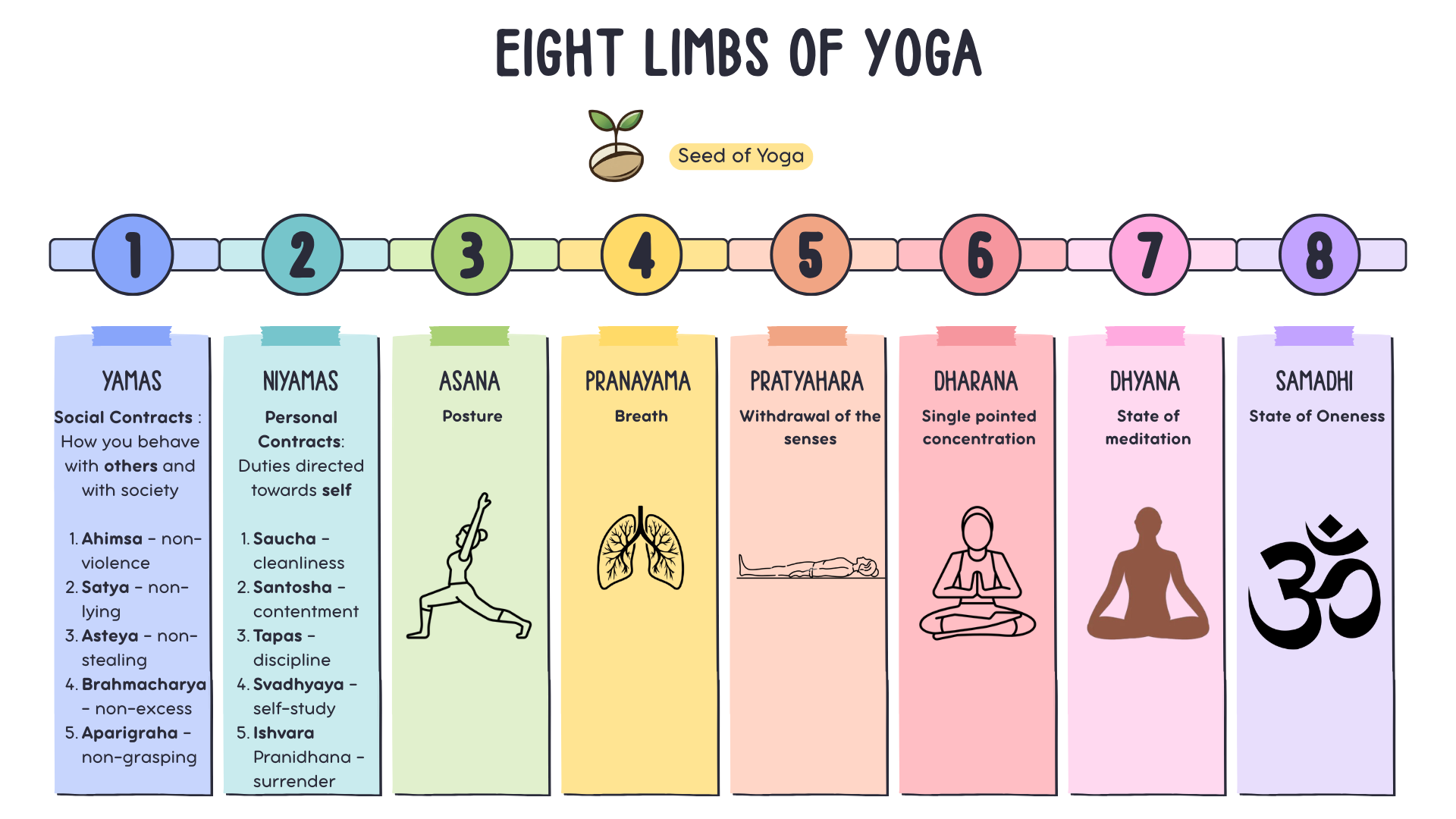
Patanjali describes yoga as a path with eight limbs — ashtanga, from ashta (eight) and anga (limb). These are not eight separate practices to choose from; they are eight dimensions of a single integrated discipline. The word “limbs” is deliberate: a body cannot function well if one of its limbs is neglected.
The eight limbs move from the most outward to the most inward. The first two address our relationship with the world and with ourselves. The next three concern the body, breath, and senses. The final three are states of increasingly refined inward absorption.
1. Yamas — Ethical principles toward others

The yamas are five guidelines for how we relate to the world. They are not commandments but observations: when these principles are violated, the mind becomes agitated; when they are practiced, the mind settles.
- Ahimsa (non-violence): not causing harm — in action, word, or thought
- Satya (truthfulness): speaking and living in accordance with what is real
- Asteya (non-stealing): not taking what has not been freely given
- Brahmacharya (right use of vital energy): traditionally understood as celibacy; more broadly as moderation and the conservation of creative energy
- Aparigraha (non-grasping): not clinging to what we have, recognizing that possessions are borrowed rather than owned
2. Niyamas — Ethical principles toward oneself

Where the yamas govern outward conduct, the niyamas are five practices of self-discipline and inner cultivation.
- Saucha (purity): cleanliness of body, environment, and mind
- Santosha (contentment): finding sufficiency in what already is, rather than in what is yet to come
- Tapas (discipline): the willingness to sustain effort even when it is uncomfortable
- Svadhyaya (self-study): the examination of one’s own patterns — through observation, and through sacred texts
- Ishvara Pranidhana (surrender): orienting oneself toward something larger than the personal self — understood as God, the universe, or the principle of awareness itself, depending on one’s tradition
3. Asana — Posture

In the Yoga Sutras, asana is defined in a single sutra: sthira sukham asanam — a posture that is steady and comfortable. Patanjali’s concern is not flexibility or strength. He is describing the quality of sitting that meditation requires: alert, relaxed, not fidgeting.
The elaborate physical practice of asana developed much later, primarily through the Hatha yoga tradition. However, the underlying principle remains unchanged: the body must be able to remain still without becoming an obstacle to the work of the mind.
4. Pranayama — Breath regulation
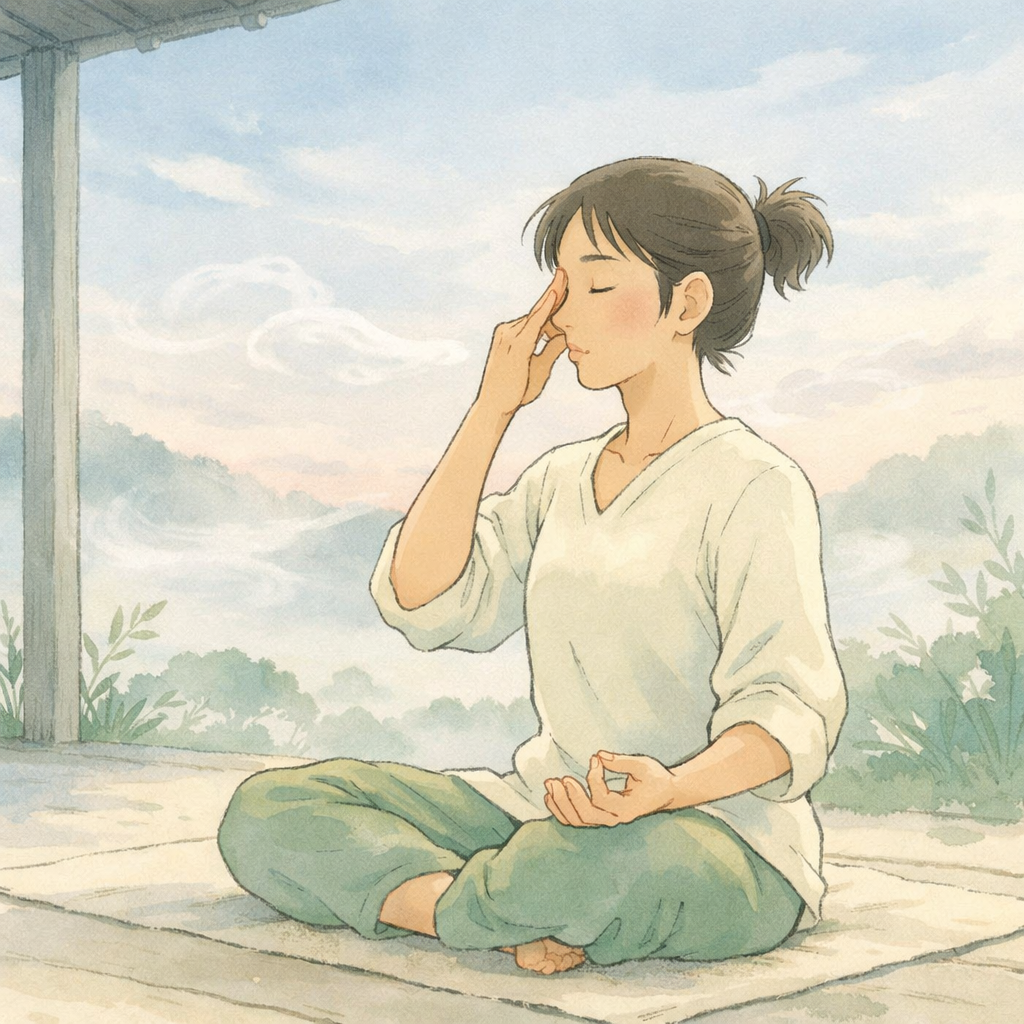
Pranayama is the regulation and extension of the breath. Prana refers to the life force — the energy said to animate all living things. Ayama means extension or expansion. Through conscious breathing, the practitioner directly influences the nervous system and, by extension, the quality of the mind.
According to the Yoga Sutras, pranayama makes the mind fit for concentration. This is not a philosophical claim — it is verifiable in one’s own experience. A long, slow exhale produces a different mental quality than a rapid, shallow breath. The breath is the most direct lever we have over the quality of attention.
5. Pratyahara — Withdrawal of the senses
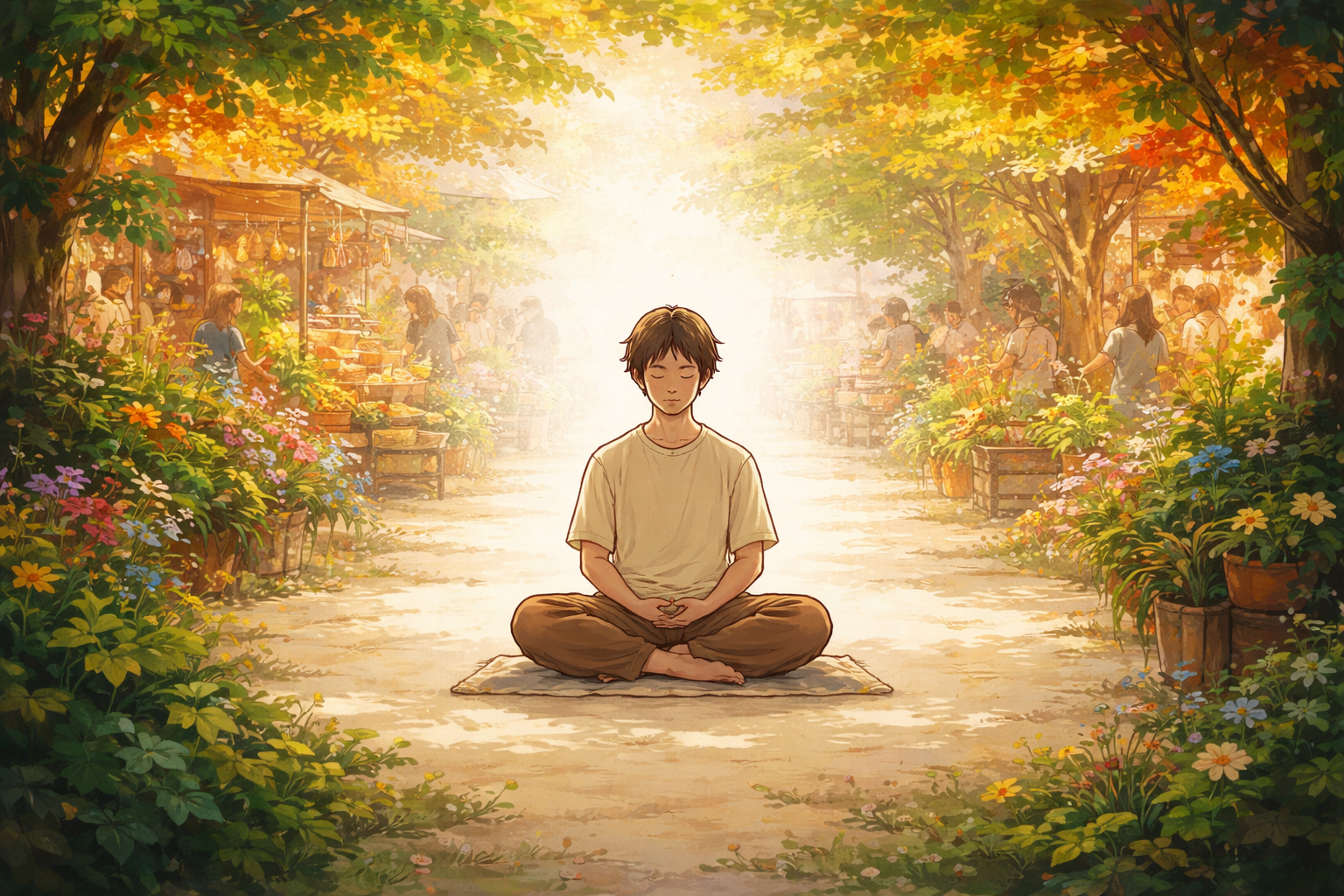
Pratyahara means drawing back, or collecting. It is the turning of attention inward, away from sensory stimulation. It does not mean shutting the senses off by force — rather, it is the natural consequence of sustained concentration: when the mind is fully absorbed in its object, it stops reaching outward for new input.
Pratyahara is the bridge limb. It connects the outer practices — the first four limbs — to the three inner ones that follow.
6. Dharana — Concentration
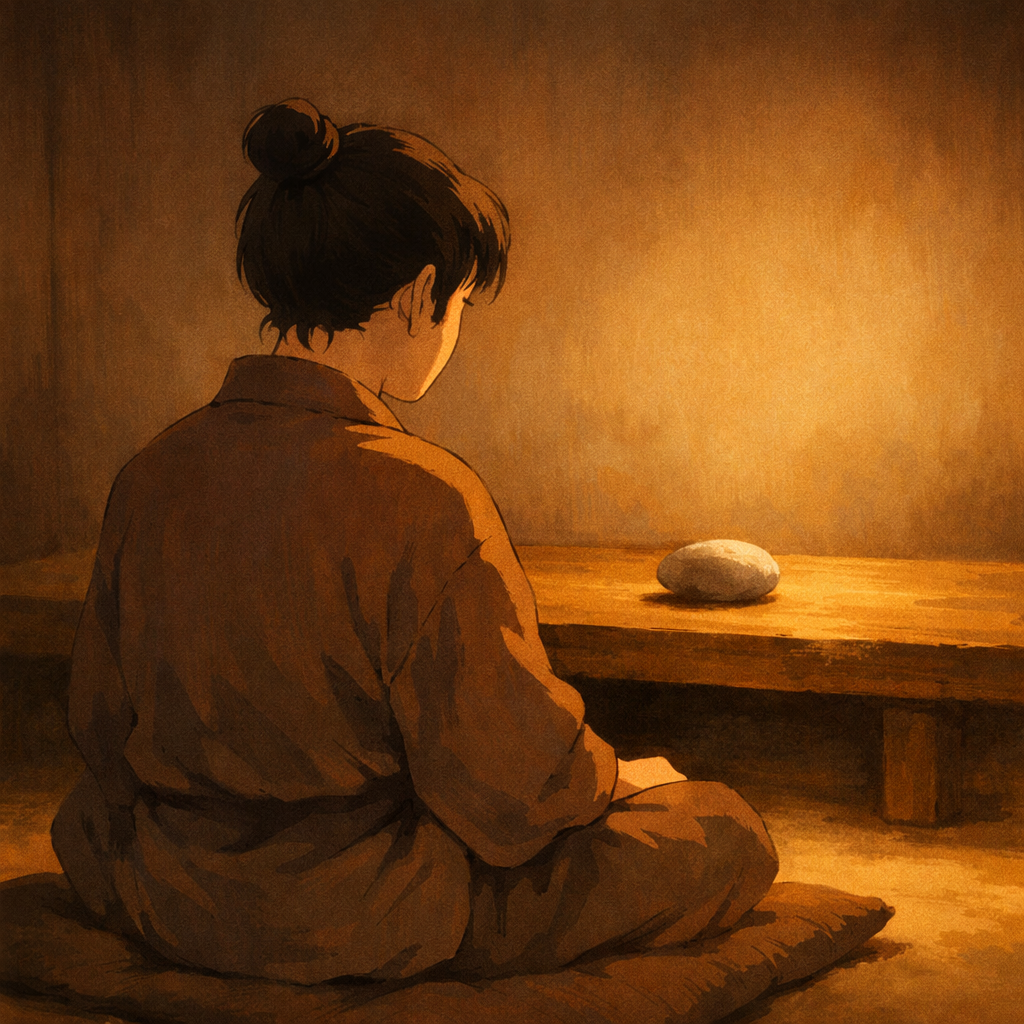
Dharana is the practice of fixing the mind on a single object and holding it there. The object can be a point on the body, a visualized image, a mantra, a flame. What is being trained is the capacity to choose where attention goes — and to return it there, repeatedly, when it wanders.
7. Dhyana — Meditation
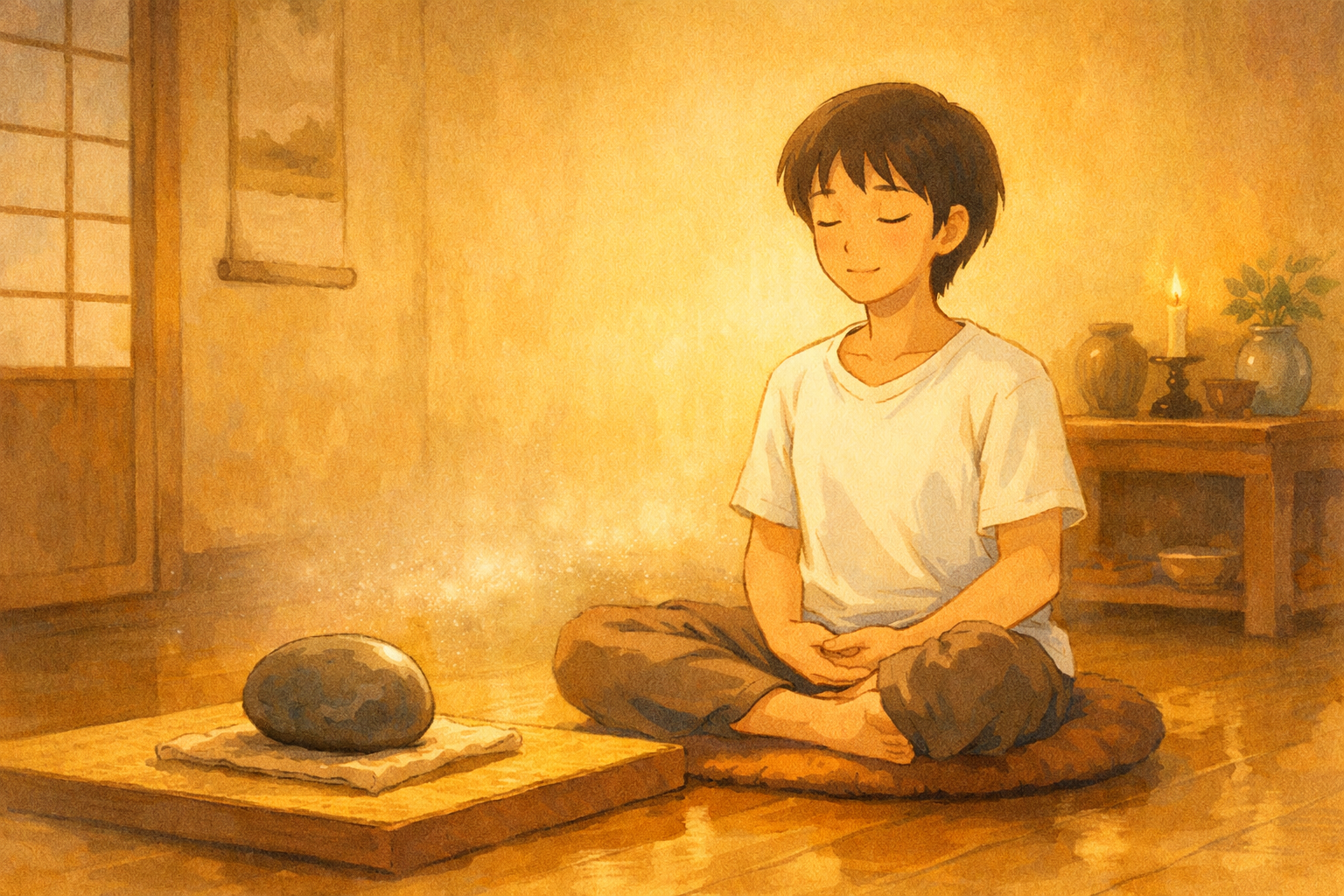
Dhyana is what happens when concentration matures: the flow of attention toward the object becomes uninterrupted. The quality of attention is the same as in dharana, but it is now sustained without the constant effort of return. The distance between the meditator and the object of meditation begins to close.
The difference between dharana and dhyana is not one of technique but of depth. You cannot decide to be in dhyana — you can only create the conditions for it through dharana.
8. Samadhi — Absorption
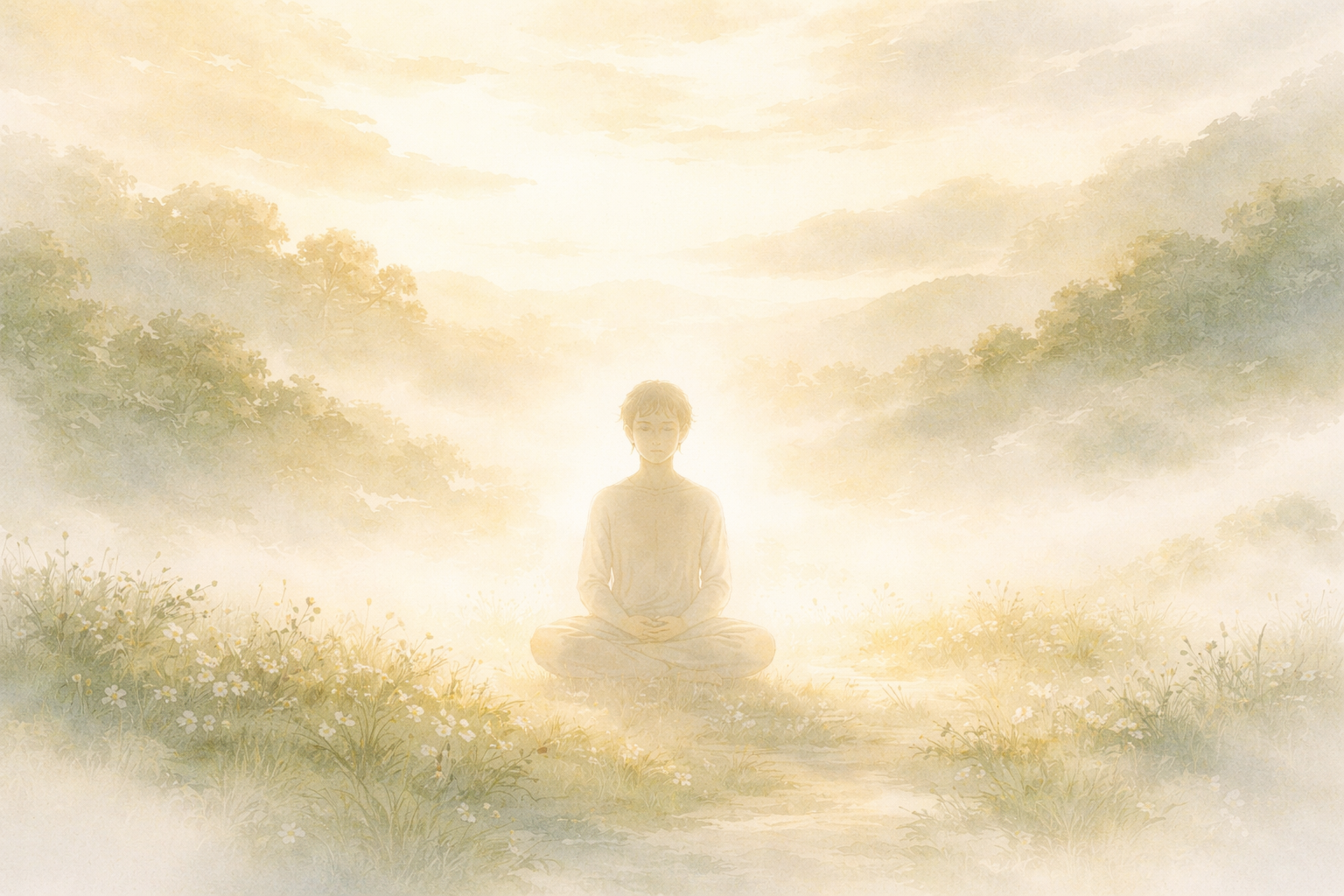
Samadhi is the culmination of the path. The mind is so fully absorbed in the object of meditation that the sense of a separate observer dissolves. What remains is awareness itself, without the coloring of the thinking mind.
Patanjali describes several levels of samadhi, from states where subtle mental processes continue to nirvikalpa samadhi, where all distinction ceases. This is the state the Yoga Sutras are pointing toward — not a distant achievement, but a recognition of what has always been present beneath the movement of the mind.
Conclusion
The eight limbs are not a ladder to climb once and leave behind. They describe a complete way of living — ethical conduct, physical care, breath, attention, and the progressive refinement of awareness toward its own source. Most of us will spend most of our practice somewhere in the first five limbs, and that is entirely appropriate.
What this framework gives us is context. When we step onto the mat, we are practicing asana — one limb of eight. That is not a diminishment of the physical practice. It is an invitation to see it as part of something considerably larger than physical fitness.
Patanjali is not asking us to leave ordinary life behind. He is pointing out that there is something worth noticing beneath it.